

Deep bedding for birds.

In the waterfowl enclosures we use deep bedding. While it's not as simple as some people make it out to be it's also not as complicated as others make it.
I know it sounds counter productive to clean less in order to have a more hygienic area. But I want to go over why it's actually better to do deep bedding if you are having a permanent run, opposed to just leaving it bare. In most cases unless its a very large run it will be bare land, they will pick at the grass so much in early growth that it will never have a chance to get established in the spring. There will be areas that they frequent like the coop and where you feed those areas will be tramped down. The water is another thing with waterfowl, if you don't have a fool proof setup around the water it will become muck and not a suitable spot for the grass to grow.
You will want to build your run to contain this deep bedding, that can be done with wood planks or trees you have harvested from your own land. It doesn't have to be perfectly inline it just needs to help hold in the bedding. You can also just use chicken wire, this is what we plan on doing for this winter. Next year we will be adding wood to the bottom layer on the sides, our enclosures are not huge but they also are not small. Since our birds have more room to move around in there through the winter the waste is more spread out which means we can get away with not as deep of bedding just to keep them off of their own waste. In order to get it composting though it needs to be thicker.
The depth of the bedding to start out should be around 6 inches minimum, if you cannot get that much at once that's okay some is better than none. But the depth is needed for the microorganisms to move in and start the actual cleaning work! To make this easier all the coming information is based off of starting with 6 inches of bedding.
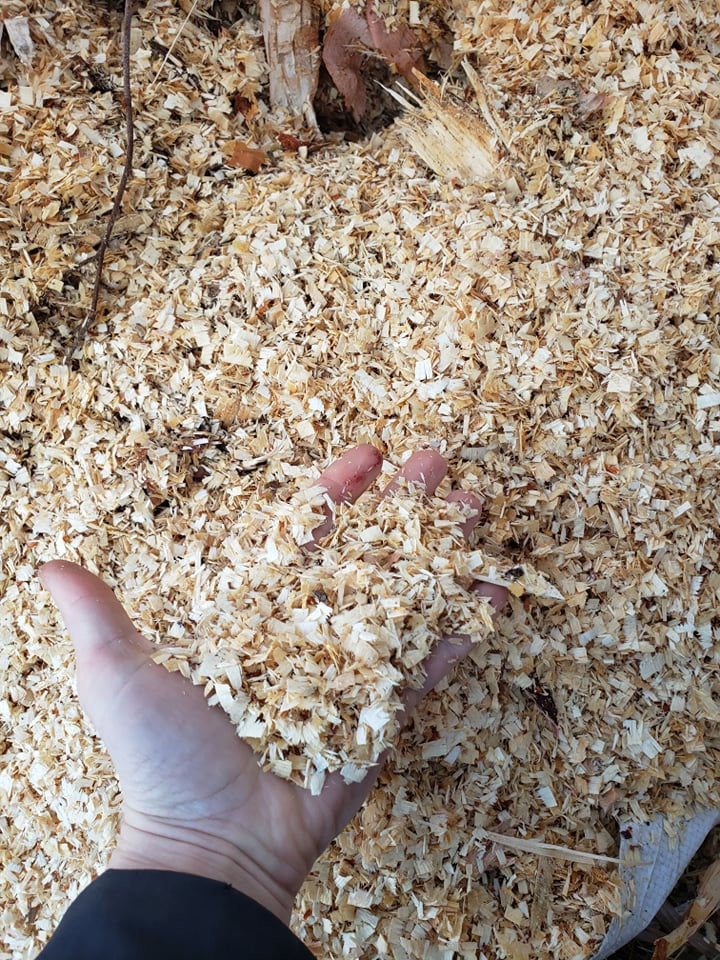
This can be an carbon based material, we use woodchips from a local woodcutter. We get some very nice quality small shavings as well as some bigger pieces of wood in the tote bags that's okay. You could even talk to your county and tell them that you are willing to be a drop off spot for woodchips from their cutters. You will want to keep your woodchip pile dry under a lean-to, even just a tarp is better than nothing.

It all comes down to a C:N ration, and I'm not talking about our farm name here. Carbon:Nitrogen you need a proper ratio, too much carbon in the deep bedding can actually cause it to get too hot, too little carbon in the deep bedding and you will have a stink to your whole enclosure.
So how do you know? It's not overly complicated if you have smell you most likely don't have enough carbon in the mix. If you are using only woody material it will be almost impossible to get your C:N ratio low enough. If your C:N ratio is too high, then it will create this white hot mold within the layers of bedding and you don't want that. Every fourth time you add to your deep bedding layers you should add a product that has more nitrogen in it. Like spent hay, grass clippings you saved, leaves you saved, etc. If you're doing this with waterfowl they would enjoy any of the above, our ducks will nibble at grass and hay and our geese eat both, they also enjoy rooting through the leaves as well. You will want to spread out more than you normally would for bedding, because they will eat some of it. Hay is a 35:1 for C:N ratio, which means it's almost ready with the perfect ratio to decompose and break down all on it's own! Leaves are another that is about 35:1, so if you can collect up bags of leaves in the fall when everyone is cleaning up their yards that's a great way to get this material you will need. Just remember with these materials that are almost the perfect ratio they will start to decompose fast if they get wet, so you will want to have a dry store area for them! As for the spent hay if you don't have a hay storage you can ask around your local farmers and you might get some 'spent hay', 'junky hay' at a reasonable cost.

This deep bedding, if created properly, will start to break down. Not only can it give off some heat for your birds through the winter, but it is also creating nice rich soil under the top layers! The bedding from your run can feed your garden, if you grow enough in your garden you can help cut feed bills by feeding your birds from it as well as kitchen scraps. You are completing a cycle; animals, earth, human. Where everything is benefiting and that is what permaculture is all about. You don't have to rotational graze your animals in order to start practicing permaculture. For us, in Canada, it would be near impossible and honestly pointless for us to combat and fight the deep snow and well below freezing temps to move around animals in our winters. Deep bedding in the enclosures is by far the best way for us to continue to practice permaculture with our waterfowl through the winter here on the Mini Farm.
Now, waterfowl are not chickens they are not going to scratch and turn the bedding as much as a chicken would. But you can encourage them to dig through the bedding with their bills by adding grains within the layers as well as tossing their feed out onto the bedding, making them forage for it like they would be doing in the summer months. If once every couple of weeks or once a month you go in with a pitch fork and just turn it over before adding in another layer, it really comes down to very little work to get 1. Compost 2. Happy active birds through the cold months 3. No mud mess in the warm months and 4. A run that doesn't smell and is hygienic.

For chickens you would want to start with 8-12 inches once a year, they will turn it over enough to keep it from getting a layer of manure on the surface. For waterfowl we start with about 4-6 inches and we add layers to it as needed. All our birds will be on it through the winter, our breeding groups will be on it through the spring as well.
Plan your run so there is easy access for a truck to back up and dump into the run or easy access for you to haul it with a tractor, ATV, or wheelbarrow depending on your size of run. Our enclosure is fairly large and we have chosen to go with the more active method of using a sled in the winter and a wheelbarrow in the warm months. To add a skim as needed doesn't take that much shavings. It sounds like more work then it really is, but plan for what you want to use in advance before building your structure.

The other benefits of doing deep bedding are beneficial bacteria will move into your deep bedding, these bacteria produce vitamin K and B-12, as well as an antibiotic substance that inhibits the growth of the bad bacteria's!
Too much nitrogen is not good for the soil, so if you are keeping your birds in one spot always and not moving them you are actually degrading the soil. By making the proper mixed C:N composting, deep bedding you will be growing the layer of black soil under that bedding and down into the earth restoring that patch of earth.
So things to remember, deep bedding needs to be oxygen-rich; if you notice your birds not rooting and turning it enough grab a tool and help them out. If you have smell it's from one of 2 things; either because it wasn't turned enough which created a hostile anaerobic environment where the good bacteria's cannot live or because you don't have enough carbon in the mix.
By using the science behind this composting, deep-bedding system you will be protect the soil and environment around your birds, keep your birds healthy, keep them warmer, and create nice rich compost for your gardens. Not to mention rid yourself of that typical 'farmyard' smell of manure!


Comments